
Dear VitalityLink Community,
Communication is a vital skill in all aspects of life, especially in healthcare. As a doctor with extensive experience in research, decision support, and clinical practice, I know how important it is to communicate effectively with patients, colleagues, and others.
One of the key components of effective communication is active listening. Active listening is the ability to listen attentively, empathetically, and nonjudgmentally to what someone is saying. It involves not only hearing the words, but also understanding the meaning, emotions, and intentions behind them.
In this newsletter, I will share with you some tips on how to practice active listening in your daily conversations. These tips are based on scientific evidence and personal experience, and they can help you improve your relationships, your work performance, and your well-being.
I will also share with you some other skills that can complement and enhance your active listening skills. These skills are:
– Assertiveness: Assertiveness is the ability to express your thoughts, feelings, and needs in a clear, respectful, and confident way. It also means respecting the thoughts, feelings, and needs of others. Assertiveness can help you communicate your expectations, boundaries, and preferences effectively. It can also help you avoid conflicts, misunderstandings, and resentment.
– Empathy: Empathy is the ability to understand and share the emotions of another person. It also means showing compassion and care for their well-being. Empathy can help you connect with others on a deeper level. It can also help you respond to their needs and concerns appropriately.
– Feedback: Feedback is the process of giving and receiving constructive information about one’s performance or behavior. It also means acknowledging and appreciating the strengths and achievements of others. Feedback can help you improve your skills, knowledge, and attitude. It can also help you motivate and support others in their growth and development.
– Negotiation: Negotiation is the process of reaching an agreement or a compromise with another party. It also means finding a solution that satisfies both parties’ interests and needs. Negotiation can help you resolve conflicts, problems, and disputes effectively. It can also help you build trust and cooperation with others.
Now that you know what other skills can improve your communication, let me share with you some tips on how to practice active listening in your daily conversations.
1. Introduction to Active Listening:
Active listening starts with setting a clear intention for the conversation. You should aim to understand the other person’s point of view, feelings, and needs. This will help you build rapport, trust, and respect with them.
To show that you are listening actively, you should eliminate any distractions that might interfere with your attention. For example, you should put away your phone, turn off the TV, or close the door if possible. You should also show the other person that you are interested in what they are saying by using verbal and nonverbal cues.
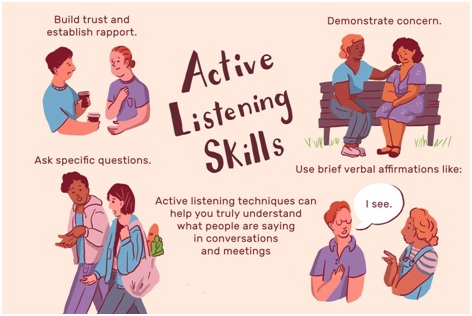
This image shows some examples of verbal and nonverbal cues that can indicate active listening.
2. Building Mindful Presence:
Active listening requires being mindful of the present moment. You should focus on what the other person is saying, rather than on your own thoughts or judgments. You should acknowledge that your mind might wander from time to time, but you should bring it back to the conversation whenever you notice it.
Being mindful also means being aware of your own emotions and reactions. You should try to manage any negative feelings that might arise during the conversation, such as anger, frustration, or boredom. You should also avoid interrupting or arguing with the other person, even if you disagree with them.

This image shows some tips on how to practice mindful listening.
3. Asking Insightful Questions:
One of the best ways to demonstrate active listening is to ask questions that reflect what you have heard. Asking questions can help you clarify any misunderstandings, confirm any assumptions, and explore any gaps in your knowledge. It can also encourage the other person to share more information and express their feelings more openly.
When asking questions, you should use open-ended questions that start with words like “what”, “how”, or “why”. These questions invite the other person to elaborate on their thoughts and opinions, rather than giving yes or no answers. You should also use reflective questions that restate what you have heard in your own words. These questions show that you have listened carefully and understood what the other person has said.
4. Don’t Focus on Your Response:
A common mistake that people make when listening is to focus too much on what they are going to say next. This can prevent them from listening fully and attentively to what the other person is saying. It can also make them miss important details or cues that might affect their response.
Active listening requires letting go of the need to have a perfect response. Instead of planning what you are going to say next, you should focus on what the other person is saying now. You should trust that you will be able to respond appropriately when it is your turn to speak. This will show that you are vulnerable and willing to learn from the other person.
5. Being Nonjudgmental:
Another essential aspect of active listening is being nonjudgmental. Being nonjudgmental means accepting the other person’s perspective as valid, even if it differs from your own. It also means avoiding any criticism, blame, or advice that might make the other person feel defensive or offended.
Being nonjudgmental can be challenging, especially when dealing with sensitive or controversial topics. However, it is important to remember that the goal of active listening is not to win an argument or change someone’s mind, but to understand them better. You should try to adopt an attitude of curiosity and openness towards the other person’s views and experiences. You should also acknowledge any biases or prejudices that you might have and try to overcome them.
6. Effective Posture and Body Language:
Your posture and body language can also affect how well you listen and how well you are perceived as a listener. You should maintain eye contact with the other person to show that you are paying attention and interested in what they are saying. You should also adopt an open posture that signals that you are receptive and noncritical of what they are saying. For example, you should avoid crossing your arms or legs, leaning back or away from them, or frowning or shaking your head.
You should also respond physically to what you hear by using gestures and expressions that match the tone and mood of the conversation. For example, you should nod and smile when you agree or appreciate something they say or lean forward and frown when you are concerned or puzzled by something they say.
7. Taking Notes for Focus:
Depending on the context and purpose of the conversation, taking notes can also help you listen actively. Taking notes can help you maintain focus, limit distractions, and signal that you value what the other person is saying. It can also help you remember and review the key points and action items of the conversation later.
However, taking notes should not interfere with your attention or engagement with the other person. You should only take brief and relevant notes that capture the main ideas and facts of what they are saying. You should also ask for permission before taking notes, especially if the conversation is personal or confidential.
In conclusion, active listening is a skill that can be learned and improved with practice. By following these tips, you can become a better listener and communicator in your personal and professional life. You can also enhance your understanding, empathy, and respect for others, and foster more meaningful and satisfying relationships.
Thank you for reading this newsletter. I hope you found it useful and informative.
Best regards